
Safe and Secure in the Fold
ISAAC MCPHEE
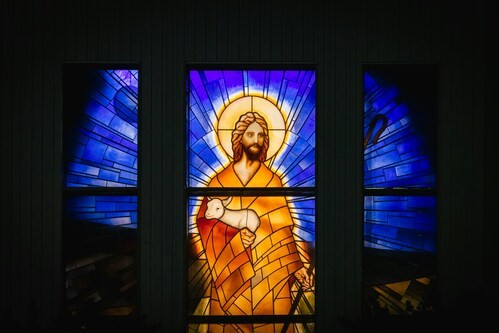
“I give them eternal life, and they will never perish, and no one will snatch
them out of my hand.”
– John 10:28
them out of my hand.”
– John 10:28
As a father, one of my greatest fears is that one of my kids would be taken from me. I’m sure all fathers can relate. I’m sure all mothers can relate. As a man, however, there is a part of me – I’d like to say it’s a small part of me, but it’s probably a bit bigger than I’d like – that says, “I’d like to see someone try.”
Fathers watch movies like Taken and think, “I get it.” We would do the unspeakable to keep our kids safe and make any sacrifice to come to their rescue. We might even secretly hope for the opportunity (or maybe that’s only me)). We walk into a public space and a corner of our brain is always making plans for how we would respond if someone ever tried to grab one of our children.
In John 10, Jesus is talking about those who have believed in him; who have heard his voice and followed him. His sheep. A shepherd is like a father and his sheep are, in a sense, his children. And so he protects them. He fends off wild animals and thieves, and he makes sacrifices to keep his flock close. Jesus calls us to join his flock, and then he promises that if we follow him we will be under his protection. We will be his sheep.
I desperately want to be able to make this promise to my children: “As long as you’re with me, you’ll be safe. Nothing bad can happen to you.” But I’m not Jesus. And I’m not Liam Neeson. I don’t actually have any special skills. I’m not trained to rescue my children if they are taken.
Jesus, unlike me, has reason for confidence. He’s confident that he will always keep and protect his sheep because he is not alone. “My Father, who has given them to me, is greater than all, and no one is able to snatch them out of the Father’s hand” (10:29).
Oh, and as if it wasn’t enough just to have the help of God the Father, Jesus makes one final, almost incomprehensibly bold statement: “I and the Father are one” (10:30). Friends, we are safe in the hands of Jesus. We are safe in his fold.
Jesus’ audience didn’t misunderstand his meaning. They didn’t fail to realize just how bold Jesus’ statement was. They immediately picked up stones to stone him – to punish him for the blasphemy of calling himself God.
But Jesus wasn’t only trying to be provocative. He wasn’t trying to make people mad. Jesus was telling the truth. And he was offering the only true source of comfort and security available to sinful humans. He was speaking to Israel – a people who had spent centuries being subjugated by larger empires, who had little sense of national or personal security. He was telling them that they could come to him and find the family, the security, the peace they had always been looking for.
Today, this remains the promise extended to all of us. “Come to me,” Jesus says in the book of Matthew, “all who labor and are heavy laden, and I will give you rest” (Matt. 11:28). He’s the one who provides rest, the one we can rely on and find security in.
It’s easy to get caught up, like these first-century Jews, in the controversy of Jesus’ declaration. It’s easy to get lost pondering the mystery of Jesus’ claims to divinity or trying to understand God’s Triune nature or the humanity of Jesus. But let’s not lose sight of Jesus’ promise. Let’s not lose sight of the God who is Shepherd, Savior, and Father – who invites us into his flock and will protect us, keep us, love us until the end.
Study Questions:
READ
EXAMINE
APPLY
PRAY
Additional Relevant Scriptures for Further Study:
READ
- Read through all of John 10. Who is Jesus’s audience? Who are the “sheep” in Jesus’ analogy, and who are the “false shepherds”?
- Read Psalm 23. How is Jesus drawing on David’s picture of God in this Psalm?
- Read through the audience’s response to Jesus beginning in verse 31. Why do you think they responded as they did?
- Jesus responds to his accusers using a quote from Psalm 82. What do you think he is trying to teach them through this quotation? Are you able to follow his logic?
EXAMINE
- Jesus makes this promise concerning his sheep: “No one will snatch them out of my hand.” What do you think this means? What are the implications of this promise?
- What is the significance of Jesus’ statement, “I and the Father are one,” in verse 30?
- What does the response of Jesus’ audience in verse 31 tell you about their priorities? What do you think their mistake is in their perception of Jesus?
- Jesus tells his audience (v. 37-38) to examine his works in order to recognize him. What do Jesus’ works say about him?
APPLY
- Do you ever feel insecure in your relationship with God? Do you ever feel like God might throw you out of his family? How can this passage encourage you?
- Do you see any practical application of Jesus’ divinity in your life? How does knowing that Jesus and the Father are “one” give you comfort in your spiritual walk?
PRAY
- Praise God for his steadfast love. Praise him for his patience and his promises.
- Thank Jesus for willingly stepping into human flesh. Thank God the Father for the promise of security and his ongoing fatherly love.
- Confess your doubts or the ways in which you’ve wandered from the fold. Pray confidently that God would hold you close to himself.
- Ask God to continue to mold and shape your heart to recognize and desire your need to find security in him alone.
Additional Relevant Scriptures for Further Study:
- On God’s shepherd heart: Psalm 23, Isaiah 40:11, Ezekiel 34:12-23
- On Jesus’ divinity: John 5:17, John 8:58, 1 Tim. 3:16, 1 John 5:20 (among many others)